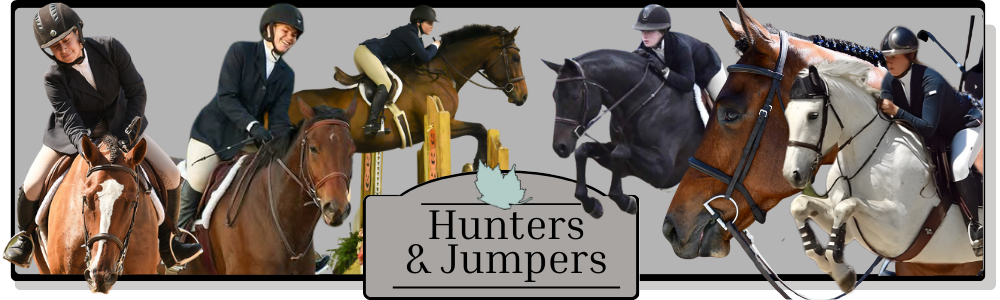
Although generally referred to simply as “hunter/jumper”, the term encompasses multiple sub-styles of riding, all of which include either riding the horse over fences, or simply riding in the same general style as one would use to ride over fences. Hunter/jumper competitions have many different classes, which fall into 3 main categories: Hunters, Jumpers, and Equitation. These three categories all involve jumping fences, but are all judged differently:
Hunters
Jumpers
Equitation
 |
In this one-on-one course on the longe line, you will be able to ain an understanding of basic riding skills for any discipline, with the support of your instructor helping to guide your horse so you can focus on learning good general posture, balance and the ability to use your aids to communicate effectively with the horse. |
 |
In this course, you will gain an understanding of basic independent riding skills in hunter seat equitation at the walk, trot, and begin going through simple ground pole exercises. With steady contact, tempo, and clear rhythm, you will improve your posture, balance, and use of the aids in both 3-point and 2-point positions as well as learn basic arena geometry and the qualities of a correct walk and trot. You will also learn how to apply these skills to be able to ride a simple ground poles course. |
 |
In this course, you will gain basic independent riding skills in dressage in the walk, trot, and canter, and in more challenging ground pole exercises. Riders will improve their posture, balance, and use of the aids in both 2-point and 3-point positions and begin to demonstrate basic control of the horse’s balance with steady contact, tempo, and clear rhythm. You will also learn to apply these skills to be able to ride a simple equitation on the flat class, as well as to ride a more complex ground poles course. |
 |
In this course, you will learn to manage your balance as well as the lateral and longitudinal balance of the horse. Riding the horse in front of the leg, from back to front, you’ll learn how to achieve having the horse reliably on the bit. You’ll be able to maintain a consistent balance from the inside leg to the outside rein on curved lines and lateral movements. The improved balance will allow you to ask for lengthening of stride and frame in trot and more challenging transitions on the flat. You will also gain a basic understanding of the lower elements of the training pyramid and use that tool to manage simple training challenges. You will be able to demonstrate a higher degree of balance, better position, and correct basics as you begin simple cross-rail trot in-canter outlines. |
 |
In this course, you will learn to manage a higher degree of balance in yourself as well as the lateral and longitudinal balance of the horse, sufficiently enough to skillfully ride in a more advanced equitation on the flat class. You will learn to maintain consistent impulsion and balance from inside leg to outside rein on curved lines and lateral movements. The improved balance allows you to ask for lengthening of stride and frame in canter, and elementary counter-canter work on the flat. You will learn to demonstrate a clear understanding of the lower elements of the training pyramid and be ready to begin more advanced work. Finally, you will be cantering simple cross-rail courses, in preparation for riding more advanced courses. |
 |
In this course, you will develop the level of balance necessary to ask the horse to accept more weight on the hindquarters. In addition to keeping the horse in front of the leg, from back to front, you are now learning how to develop the self-carriage necessary to perform the maneuvers required of this level, including collected, medium gaits, and the shoulder-in. You will also learn to rely on the training pyramid to dismantle any training challenges that arise. Finally, you’ll learn to apply what you’ve learned to courses up to 2’0” in height with oxers, combinations, and bending lines. |
 |
In this course, you will also learn to achieve the level of balance necessary to ask the horse to accept more with on the hindquarters, to the point that the forehand is beginning to lift. You will have confirmed the self-carriage necessary to perform the maneuvers required at this level. This improved balance will allow you to ask for a more dramatic lengthening of stride and frame, more challenging transitions, and more complex lateral maneuvers. You will course 2’3” to 2’9” and will jump oxers, combinations, and bending lines. |
 |
In this course, you will learn how to achieve the level of balance necessary to ask the horse to maintain a consistent uphill balance which results in a higher degree of self-carriage and more dramatic transitions between and within the gaits. You will also learn how to balance a higher degree of engagement and power by looseness and elasticity, and by allowing the horse to perform the movements with ease. |
 |
Are you thinking about taking your skills into the show ring? This course teaches you the rules, shows you what to expect, what you'll need, strategies for success, and how the whole process works from signing up to packing it all in at the end of the day. *Required for off-site showing |
 |
Leasing a horse allows you to supplement your education with time to practice in between your scheduled lessons. In this short course, you will learn the basic rules for leasing, how to schedule lease rides, some tips for more productive rides, and your responsibilities before, during, and after your lease sessions. |
 |
In this course, you will learn how to tack up with a bareback pad, how to mount and dismount when bareback, the benefits of bareback riding, and some special safety considerations fo riding successfully without a saddle. |
 |
Escape the arena, get off the beaten path, and put your skills to the test with this trail riding course. You will learn how to plan your trip, picking a safe trail, some of our top tips for tack, specialized trail equipment, and some essentials to bring with you. You will learn what to do in case of emergency, such as stopping an out-of-control horse in the open, riding around wildlife, and what to do in the event of a fall when you may not have access to medical care. |
 |
In this course, you will learn how to get started riding bridless. This includes, setting your horse (and yourself) up for success, making your seat and legs more effective, and handling the training stick and string. This lesson will teach you ways to be clearer, softer, and have better leadership when riding. |
 |
In this course, you will ditch the training stick and begin the canter and lateral movements such as the leg yield and turn on the haunches. You will start using more refined aids and doing more complex maneuvers such as side-passing and negotiating simple obstacles. |
 |
In this course, you will maneuver through complex obstacles and drastically refine the aids to a nearly invisible level. This will put your dressage, western, or hunter/jumper classes to the ultimate test. You will do lateral work, flying changes, and jumping. |
 |
 |
 |
 |
 |
 |
 |
 |
 |
 |
 |
 |
 |
 |
 |
 |
| Private Lessons | Group Lessons | |
| Level 1/White | $110.00 | Not Available |
| Level 2/Yellow | $110.00 | $90.00 |
| Level 3/Purple | $120.00 | $100.00 |
| Level 4/Orange | $120.00 | $100.00 |
| Level 5/Blue | $120.00 | $100.00 |
| Level 6/Brown | $140.00 | $120.00 |
| Level 7/Red | $140.00 | $120.00 |
| Level 8/Black | $140.00 | $120.00 |
Our lesson packages allow you purchase lessons at a discounted rate. There are standard packages, hybrid packages, and premium packages. Each standard package is a monthly subscription that includes 4 tokens for 4 private lessons or 4 group lessons.
Each subscription lasts for one season and is a season-long commitment. The seasons are:
Prices listed are per month.
| 4 Private Lessons/Month | 4 Group Lessons/Month | |
| Level 1 - White | $330.00 | Not Available |
| Level 2 - Yellow | $330.00 | $270.00 |
| Level 3 - Purple | $360.00 | $300.00 |
| Level 4 - Orange | $360.00 | $300.00 |
| Level 5 - Blue | $360.00 | $300.00 |
| Level 6 - Brown | $420.00 | $360.00 |
| Level 7 - Red | $420.00 | $360.00 |
| Level 8 - Black | $420.00 | $360.00 |
Our lesson packages allow you purchase lessons at a discounted rate. There are standard packages, hybrid packages, and premium packages. Each Hybrid Package includes 2 private lesson tokens and 2 group lesson tokens. The packages are as follows:
Each subscription lasts for one season and is a season-long commitment. The seasons are:
Prices listed are per month.
| 2 Private Lessons and 2 Group Lessons/Month | |
| Level 1 - White | Not Available |
| Level 2 - Yellow | $300.00 |
| Level 3 - Purple | $330.00 |
| Level 4 - Orange | $330.00 |
| Level 5 - Blue | $330.00 |
| Level 6 - Brown | $390.00 |
| Level 7 - Red | $390.00 |
| Level 8 - Black | $390.00 |
Our lesson packages allow you purchase lessons at a discounted rate. There are standard packages and premium packages. Each premium package is a monthly subscription that includes 8 tokens for 8 private lessons or 8 group lessons. The packages are as follows:
Each subscription lasts for one season and is a season-long commitment. The seasons are:
Prices listed are per month.
| 8 Private Lessons/Month | 8 Group Lessons/Month | |
| Level 1 - White | $616.00 | Not Available |
| Level 2 - Yellow | $616.00 | $504.00 |
| Level 3 - Purple | $672.00 | $560.00 |
| Level 4 - Orange | $672.00 | $560.00 |
| Level 5 - Blue | $672.00 | $560.00 |
| Level 6 - Brown | $784.00 | $672.00 |
| Level 7 - Red | $784.00 | $672.00 |
| Level 8 - Black | $784.00 | $672.00 |
| Show Deposit (Non-Refundable) | $150.00 |
| Horse Show Day Coaching per Day | $150.00 |
| Non-Showing Schooling Day Coaching per Day | $100.00 |
| Horse Use Fee for Non-Leased Horses | $125.00 |
| Horse Use Fee for Leased Horses | $75.00 |
| Non-Recognized Classes Pro Ride | $25.00 |
| Recognized Classes Pro Ride | $50.00 |
For a full, detailed look into our upcoming show season, click HERE.
| Per 1 Mile (One Way) | $2.00 |
| ONE-WAY DISTANCE | PRICE |
| Minimum Charge | $100.00 |
| 0-50 miles | $4.00 per mile |
| 51-100 miles | $3.50 per mile |
| 101-499 miles | $3.25 per mile |
| 500+ miles | $3.00 per mile |
| WASHINGTON COUNTY FAIRGROUNDS - Lake Elmo, MN (3 miles, 1 way) | $100.00/round trip |
| STONEGATE FARM - Stillwater, MN (8 miles, 1 way) | $100.00/round trip |
| CARRIAGE HOUSE FARM - Hugo, MN (15 miles, 1 way) | $100.00/round trip |
| MINNESOTA STATE FAIRGROUNDS - Hugo, MN (15 miles, 1 way) | $100.00/round trip |
| SIMONS ARENA - Cannon Falls, MN (39 miles, 1 way) | $312.00/round trip |
| ALPINE FARMS - Long Lake, MN (39 miles, 1 way) | $312.00/round trip |
| GOLDEN GATE EQUESTRIAN CENTER - Jordan, MN (56 miles, 1 way) | $392.00/round trip |
| NORTH IOWA EVENTS CENTER - Mason City, IA (152 miles, 1 way) | $226.00/round trip |
| LEDGES SPORTING HORSES - Roscoe, IL (302 miles, 1 way) | $988.00/round trip |
| LAMPLIGHT EQUESTRIAN CENTER - Wayne, IL (310 miles, 1 way) | $2,015.00/round trip |
| WEC OHIO - Wilmington, OH (727 miles, 1 way) | $4,362.00/round trip |
| KENTUCKY HORSE PARK - Lexington, KY (757 miles, 1 way) | $4,542.00/round trip |
Event schedule coming soon!
Whether you're just starting out or you're wanting to continue your hunter/jumper journey, we're here to help. Click here to book your assessment lesson today. We look forward to helping you achieve your goals!
The Professional Development Program is the cornerstone of the riding intruction and training program at Windfall Equestrian Center. Tailored to riders in dressage, hunt seat, and western disciplines, this program consists of 8 levels, each more challenging than the last. Click here to purchase one of our course catalogs for a deep dive into our courses within our professional development program and lesson program, both in-person and online.
For more information regarding fees and benefits, click here